
- What is a general agent, and what is a task-scoped agent
- Where is the general agent better
- Where is the task-scoped agent better
- The real problem with small agents is the handoff
- Who decides which agent runs
- Which one would I let run the command
- What does the task-scoped approach cost
- How do the two compare
- How to decide for one piece of work
- Summary
- FAQs
There are two ways to build an agent for ops. One general agent that can do anything you ask, or many small agents that each do one job. This post compares them on one question: which one would you let run a command in production. I go through where each is better, including the real problem with small agents, which is the handoff between them. My answer is a split. A general agent is fine for read actions. Change actions need agents narrow enough to test and to write a rule for.
One disclosure, and it matters more here than in my other posts. I work on NudgeBee, and task-scoped agents are what we build. I have tried to give the general agent its real strengths. Please read this with that in mind.
This is the third post in a series. The first covered why most agent setups in ops stay read-only. The second covered the five stages of agentic ops maturity.
What is a general agent, and what is a task-scoped agent
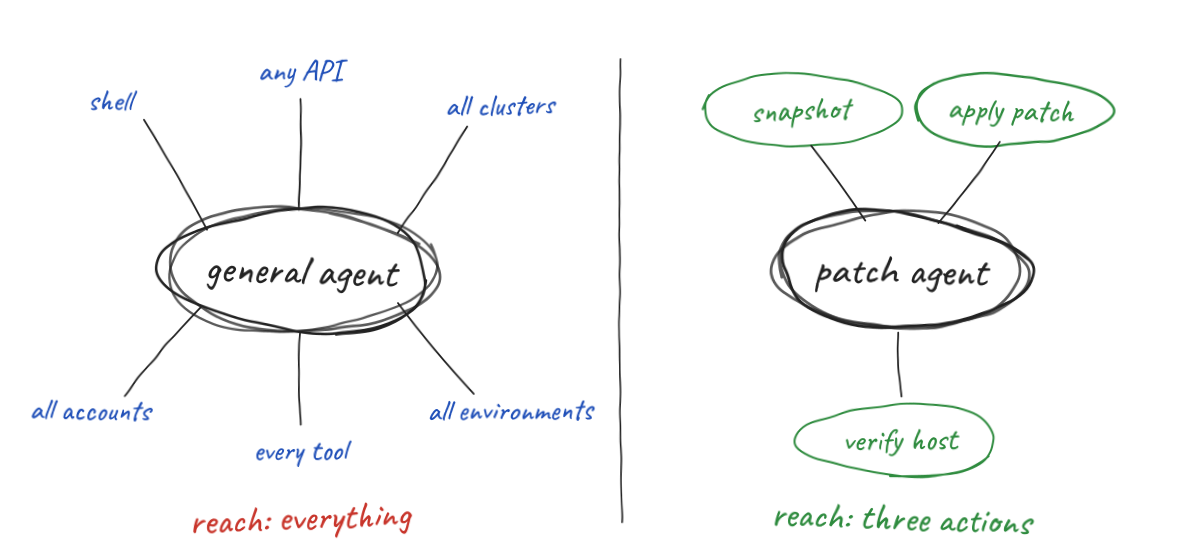
A general agent has one broad prompt, a wide set of tools and usually a shell. You give it a goal and it works out the steps. The assistant in your terminal is a general agent.
A task-scoped agent does one job. It has a short list of defined actions and the access for those actions only. A patch agent can take a snapshot, apply a patch and verify the host. It cannot resize a database, because that action is not in its list.
The difference is in what each one can reach. Both reason about the problem in front of them.
Where is the general agent better
The general agent is better when nobody knows in advance what the work will be.
- Unknown problems. A new kind of failure has no agent built for it. A general agent can at least investigate.
- The long tail. Ops has many rare tasks. Nobody will build and test an agent for each of them.
- Work that crosses domains. A cost problem caused by a deploy, caused by a config change, does not belong to one narrow agent.
- Speed to start. One general agent is useful on the first day. Twenty narrow agents take time to build.
- Less to maintain. One prompt and one set of tools, against twenty prompts and twenty owners.
These are real advantages. For read actions, where a wrong answer costs a few minutes, they often decide the matter.
Where is the task-scoped agent better
The task-scoped agent is better when the work is known, repeats, and changes something.
- Consistent runs. A small set of actions and a fixed job leave fewer ways for two runs to differ.
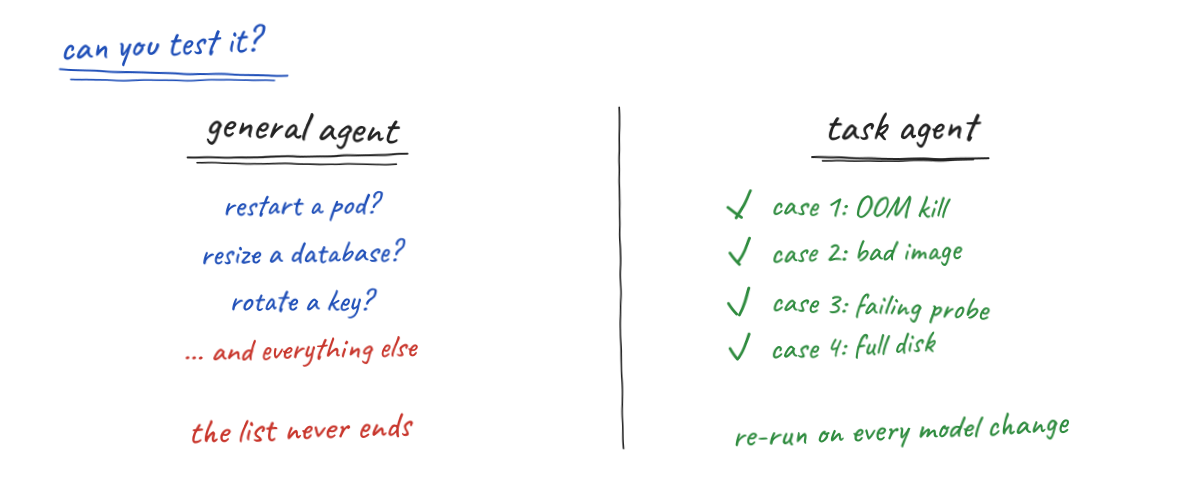
- It can be tested. I can write an eval set for diagnosing a crash-looping pod. I cannot write a complete one for doing anything in a cloud account.
- The rule is short. A narrow agent needs a few defined actions, so its policy fits on one screen. A general agent needs access to everything, and that brings back the all-or-nothing access problem from the first post.
- A mistake reaches less. A wrong decision can only touch the few actions that agent has. The same holds for an instruction hidden in a log line or a ticket that the agent reads.
- Model changes are manageable. When a new model arrives, I run a fixed eval set per agent and compare. A general agent has no fixed set to run.
- Lower cost per run. A narrow job needs a short prompt and less context, and often a smaller model.
- A clear record. The patch agent ran step four under one named rule. One team owns that agent, its evals and its rule.
I have not published measurements for these points. They come from building these agents and from the teams I talk to.
Find the root cause faster
NudgeBee finds the root cause of an incident, with evidence, and suggests a fix. Runs self-hosted in your own environment.
The real problem with small agents is the handoff
Small agents have to pass work to each other, and every handoff can lose or bend information. This is the strongest argument against them.
I made this argument myself in the first post. Three agents in a chain that are each 90% right give about 73%. That arithmetic does not care whether the agents are narrow or general.
Three things reduce it. They do not remove it.
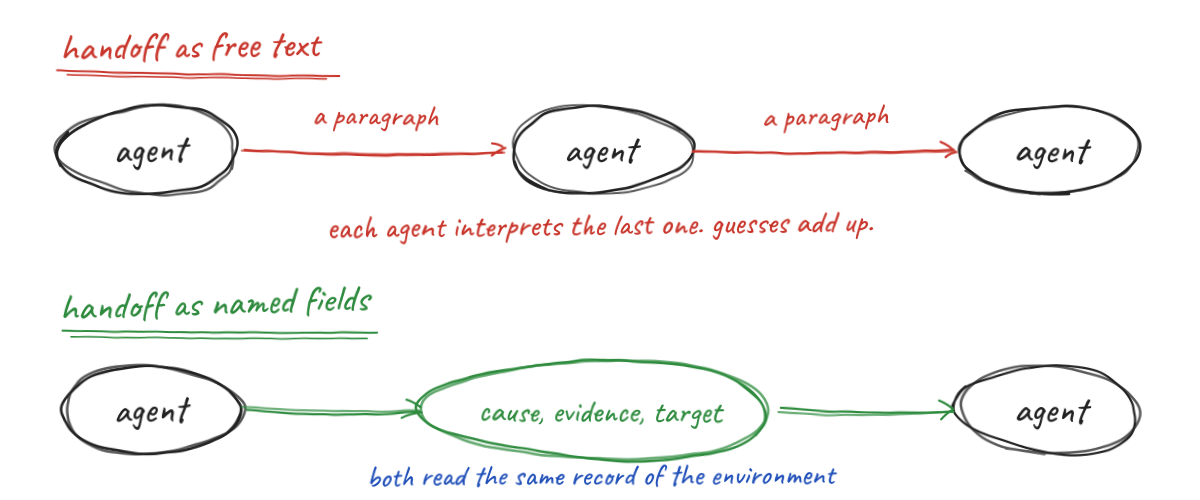
- Pass structured results. The next agent gets the cause, the evidence and the target as named fields. It does not get a paragraph to interpret.
- Share one record of the environment. Each agent reads what depends on what from the same place, and does not rebuild it from the previous agent's summary.
- Keep the chain short. Two hops for most work. A long chain is a sign that the jobs were cut too small.
Who decides which agent runs
Something has to look at the work and pick the agent. In most designs this router is itself a general agent, and that is fine under one condition: it only reads and routes.
The router can look at the alert, ask questions and choose the patch agent. It has no change actions of its own. A router that can also change production is a general agent with extra steps, and the problem has only moved.
Which one would I let run the command
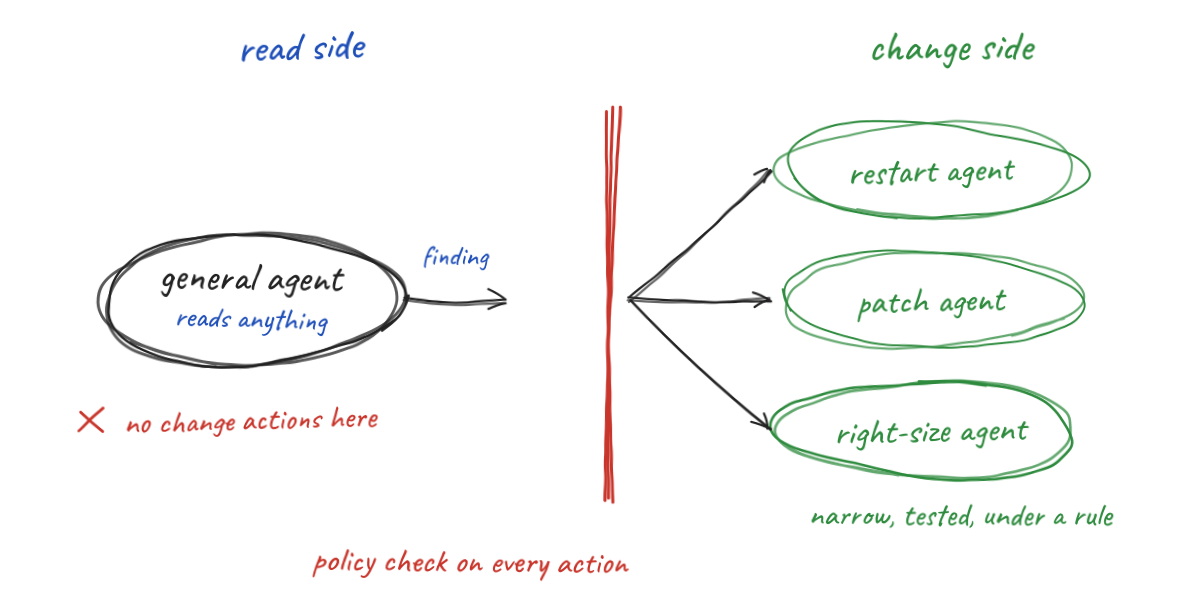
I would let a general agent read anything, and I would let only task-scoped agents make changes.
The split follows the wall from the second post. On the read side a wrong answer costs time, and the general agent's range is worth more than its inconsistency. On the change side a wrong action costs an outage, and I want an agent I can test and a rule I can read.
In practice it works like this.
1. A general agent investigates. It may read across every tool and every environment.
2. It hands a structured finding to the task agent for that kind of work.
3. The task agent proposes the change, one defined action at a time.
4. A policy check outside the model decides each action: run it, ask a person, or deny it.
The task agent still reasons. It reads the situation and decides which of its actions fits and in what order. It is narrow in what it can touch, and it is not a script.
How teams actually run it
Four AI assistants sharing one context across SRE, FinOps, Kubernetes and CloudOps, with every change gated on human approval.
What does the task-scoped approach cost
The task-scoped approach costs more work up front, and I do not want to hide that.
- Evals have to be built. Somebody collects real cases, writes the expected result and keeps the set current. An agent without this set is narrow and still untested.
- Each agent needs an owner. Its prompt, its actions, its evals and its rule belong to somebody.
- The tail stays manual for longer. Rare tasks get an agent late or never. For those, the general agent recommends and a person runs the change.
- Cutting the jobs is a design problem. Jobs cut too large bring back the general agent. Jobs cut too small bring back the handoff problem.
How do the two compare
| Factor | General agent | Task-scoped agent |
|---|---|---|
| Unknown problems | Strong, it can investigate anything | Weak, no agent exists for a new kind of problem |
| Rare tasks | Covered from day one | Covered late or never |
| Same result on repeated runs | Hard to hold | Easier, few actions and one job |
| Testing with an eval set | No complete set is possible | A fixed set per agent |
| Policy | Needs broad access, the rule is long | Few actions, the rule is short |
| What a mistake can reach | Everything it has access to | The actions of that one agent |
| A new model version | No fixed test to run | Run the eval set and compare |
| Cost per run | Long prompt, large context | Short prompt, often a smaller model |
| Work across domains | Natural | Needs handoffs |
| Effort to start | Low | High |
| Effort to maintain | One agent | Many agents, evals and owners |
Start free, any scale
Readable source, self-hosted, and free at any scale. 2 clusters or cloud accounts free on Cloud SaaS.
How to decide for one piece of work
For one piece of work, I ask four questions.
1. Does it change anything, or only read?
2. Does it repeat often enough to justify an eval set?
3. Can I list its actions on one screen?
4. What can a mistake reach?
Work that only reads, or that happens twice a year, can stay with a general agent. Work that changes production and repeats every week should get its own agent, its own evals and its own rule.
Summary
- A general agent has broad tools and works out its own steps. A task-scoped agent does one job with a short list of defined actions.
- The general agent is better for unknown problems, rare tasks and work that crosses domains.
- The task-scoped agent is better for repeatable results, testing, short policy rules and limiting what a mistake can reach.
- The weak point of small agents is the handoff. Structured results, one shared record of the environment and short chains reduce it.
- I would let a general agent read anything and let only task-scoped agents make changes, with a policy check on every action.
- The task-scoped approach costs more up front: evals, owners and careful cutting of the jobs.
I would like to hear where your experience is different, most of all from teams that run a general agent with write access in production.
FAQs
A general agent has one broad prompt, a wide set of tools and usually a shell. You give it a goal and it works out the steps.
A task-scoped agent does one job. It has a short list of defined actions and the access for those actions only.
The general agent is better when nobody knows in advance what the work will be.
For read actions, where a wrong answer costs a few minutes, they often decide the matter.
Small agents have to pass work to each other, and every handoff can lose or bend information.
Three agents in a chain that are each 90% right give about 73%.

Rakesh Rajendran is Founder & CEO of NudgeBee, where the team builds an Agentic Operations and Automation Platform that helps cloud, SRE, FinOps and platform engineering teams run AI agents safely in production.
He has spent two decades building distributed systems for large enterprises, and holds a patent in distributed photo-processing workflows developed at Walgreens. As a serial entrepreneur and intrapreneur, he has built and taken multiple products to market, and speaks regularly on building enterprise-grade agentic systems that meet real enterprise standards for security, control and scale.
Most of his time now goes to one problem: closing the gap between an AI agent that demos well and one an enterprise can actually trust on production systems. Find him on LinkedIn or reach the team at nudgebee.com.