
- What is agentic ops maturity
- Read actions and change actions
- What are the five stages
- One ticket at each stage
- Real ops work is many kinds of work, in several steps
- Who does what at each stage
- Where are most teams today
- Why one setting cannot cover every environment
- Stage 4: you approve each change
- Why a team cannot stay at stage 4
- Stage 5: you approve the rule
- Why maturity is a grid and not one number
- How to move from stage 3 to stage 5
- Check your own setup
- Summary
- FAQs
Agentic ops is used today for very different things. A chat window that reads your logs gets the name. A system that patches hosts on its own gets it too. This post sorts it into five stages with one question: who runs the command, and who said yes. It follows one ticket through all five stages. Then it looks at real ops work, which is many kinds of work, done in several steps, across environments with different risk. It explains why approving every change by hand becomes a bottleneck, the same way pull request reviews did, and how rules per action and per environment get past that.
One disclosure. I work on NudgeBee, where we build agents for ops. This post is about the model, and I keep the product out of it.
What is agentic ops maturity
Agentic ops maturity is how far you trust an agent to go on a piece of ops work. At the low end it answers a question. At the high end it makes a change under a rule you wrote.
I measure it with one question, asked for any piece of work: who runs the command, and who said yes?
The answer puts that work at one of five stages.
Read actions and change actions
Every step an agent takes is an action. Some actions only look. Some change things.
- Read actions leave the system as they found it: get the logs, compare the cost, find the root cause, recommend a fix.
- Change actions alter the state of something: restart a pod, roll back a deploy, resize an instance, apply a patch.
A recommendation is still a read action. Nothing has changed until somebody runs the command. I wrote more about this in an earlier post, which also covers why most setups stay on the read side.
What are the five stages
The five stages are: answers, investigates, recommends, makes the change with your approval, and makes the change under your rule. The first three are read actions. The last two are change actions.
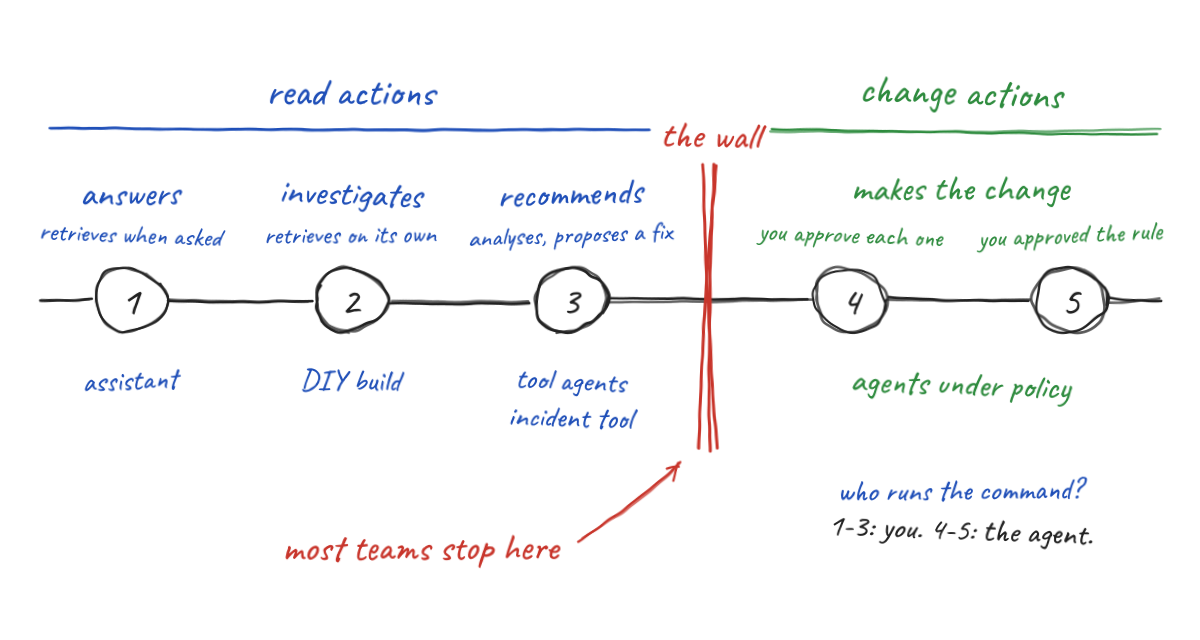
1. Answers. You ask, it retrieves. It works only when you are at the keyboard.
2. Investigates. An alert or a ticket starts it. It retrieves and correlates on its own, and posts what it found.
3. Recommends. It analyses and proposes a fix, often with the exact command. You run that command, with your own access.
4. Makes the change, you approve each one. It shows you the change. You say yes. It runs the change itself.
5. Makes the change, you approved the rule. You said yes once, in advance, for a defined kind of change. It runs those and tells you after.
In stages 1 to 3 you run the command. In stages 4 and 5 the agent runs it. I call that line the wall.
One ticket at each stage
Take one ordinary ticket. The checkout pod keeps restarting because it runs out of memory.
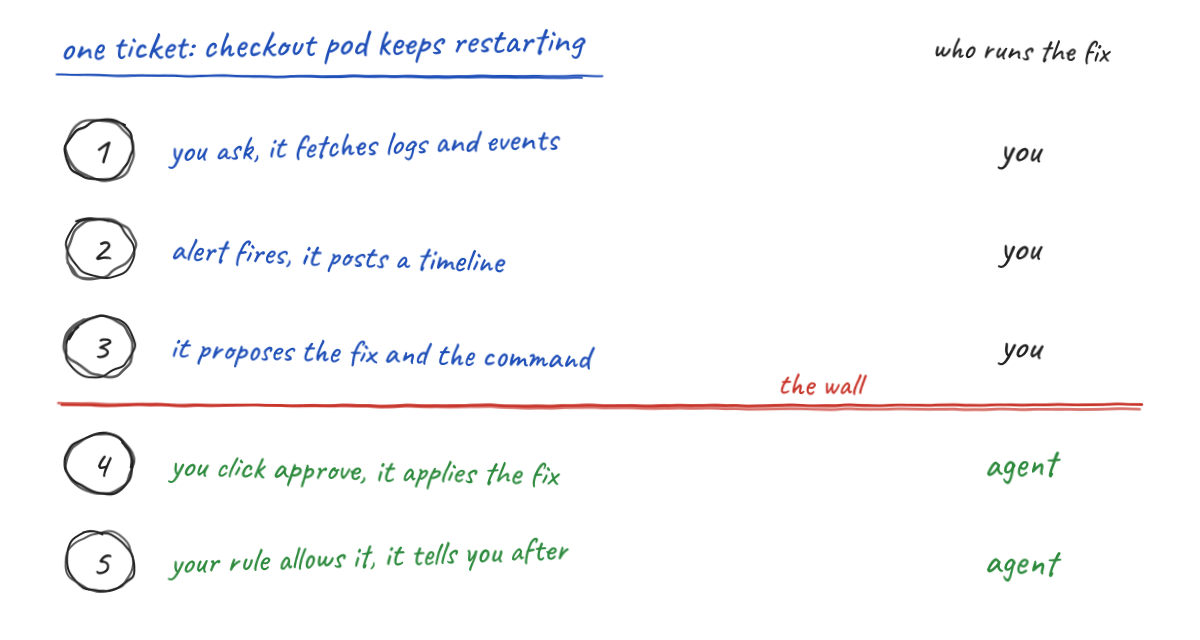
1. Stage 1. You ask why checkout is restarting. It pulls the logs and the events and answers. You do the rest.
2. Stage 2. The alert fires. The agent pulls logs, events and the last deploy on its own, and posts a timeline. You diagnose and fix.
3. Stage 3. The agent says the memory limit is too low since the last release, and gives you the command. You copy it and run it.
4. Stage 4. The agent posts the same finding with an approve button. You click. It applies the change and confirms the pod is healthy.
5. Stage 5. Your rule already allows a memory increase up to a limit in that namespace. The agent does it and tells you. A bigger increase than the limit would come to you first.
The ticket is the same at every stage. From stage 3 onwards the diagnosis is the same too. What changes is who runs the fix.
Find the root cause faster
NudgeBee finds the root cause of an incident, with evidence, and suggests a fix. Runs self-hosted in your own environment.
Real ops work is many kinds of work, in several steps
That ticket is a troubleshooting example. Troubleshooting makes agents look simple: several read steps and one change at the end. Most demos of ops agents look like this. Most ops work has a different shape.
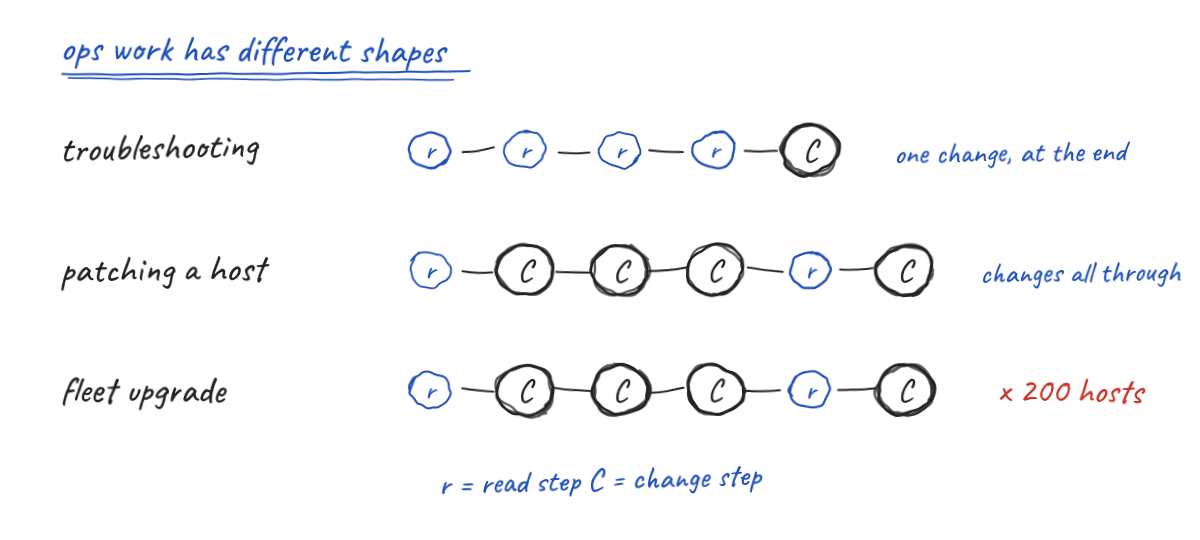
Two things about real ops work matter for the rest of this post.
It is many kinds of work. Incidents, patching, upgrades, right-sizing, access requests, certificates, backups, database maintenance. They differ in how often they happen, how many steps they take and how much can go wrong. One agent and one stage do not cover all of them.
Most outcomes take several steps. Patching a host is a run of steps, and the steps are not alike.
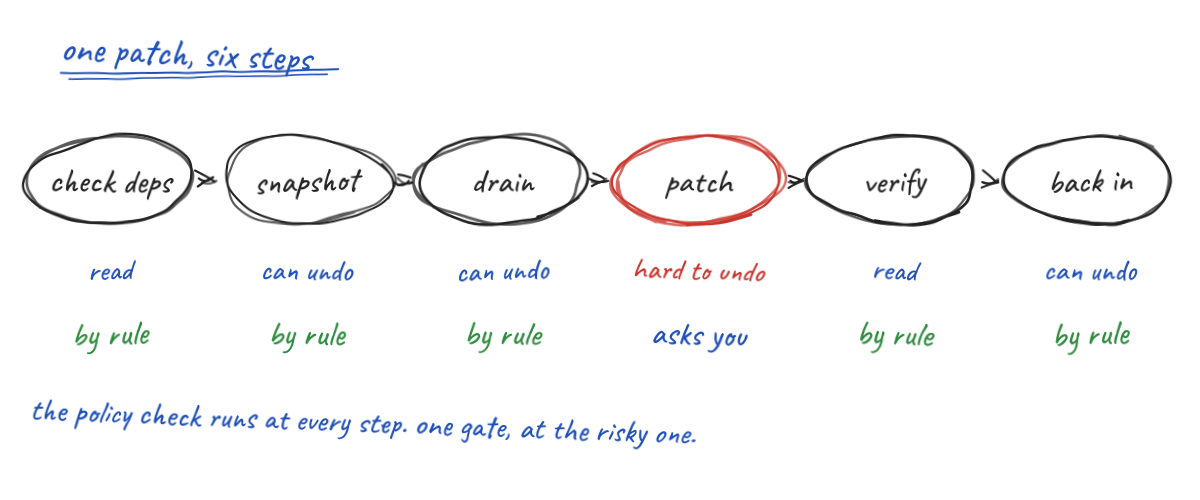
Some steps only read. Some can be undone. One is hard to undo. So I ask the question per step: who runs this step, and who said yes to it.
A run also has to be able to stop in the middle. When step four fails, or waits for an approval, the system must hold its state and know the way back. A single command never needed that.
Who does what at each stage
Any piece of ops work has four parts: find the cause, propose the fix, say yes, run the command. The stages differ in who does each part.
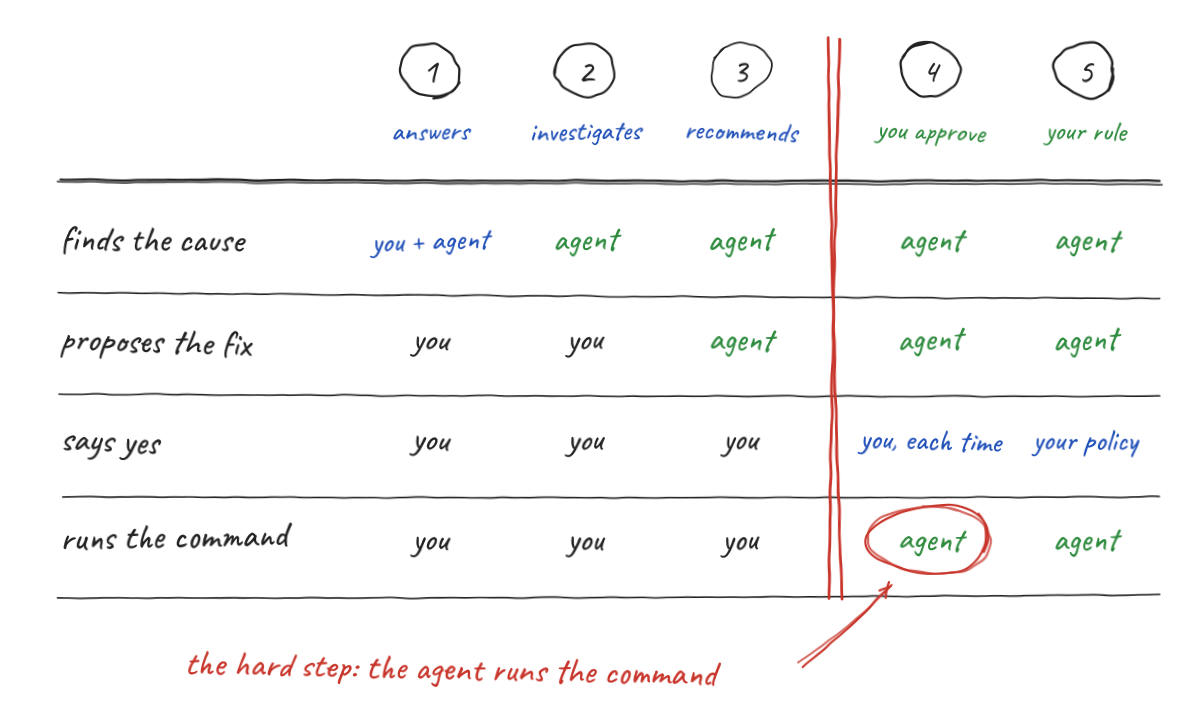
Read the grid row by row. Finding the cause moves to the agent first. Proposing the fix moves next. Saying yes stays with you to the end, and at stage 5 it is still your rule. Running the command is the row that crosses the wall.
Where are most teams today
From the teams I talk to, most are at stage 2 or 3 for most of their work. The agent investigates and recommends. A person runs everything.
Reaching stage 3 depends on better answers. Going past it is a different kind of problem. An agent that runs the command needs four things that reading never needed:
- Its own identity. Not your login, and not one shared service account.
- Permission per action. Access for the one change, and not for everything the agent might ever do.
- A record of the yes. Who approved, or which rule allowed it.
- A way to undo. Known before the change runs.
Most setups today have none of the four, because they were built to read. The only safe setting is then read-only, and the team stays at stage 3. I went through the reasons in the earlier post.
Why one setting cannot cover every environment
There is one more reason teams stay on the read side, and it is a practical one. Most setups have one setting for all environments, so production decides for everyone.
What you allow in dev or staging, you will not allow in production. That is reasonable. Take a cost optimisation that resizes instances, a patch, or a fix for a vulnerability. In dev the risk is small. In production it is not.
Most setups cannot express that difference. The agent has one identity and one set of permissions. The change is too risky for production, so it is switched off everywhere.
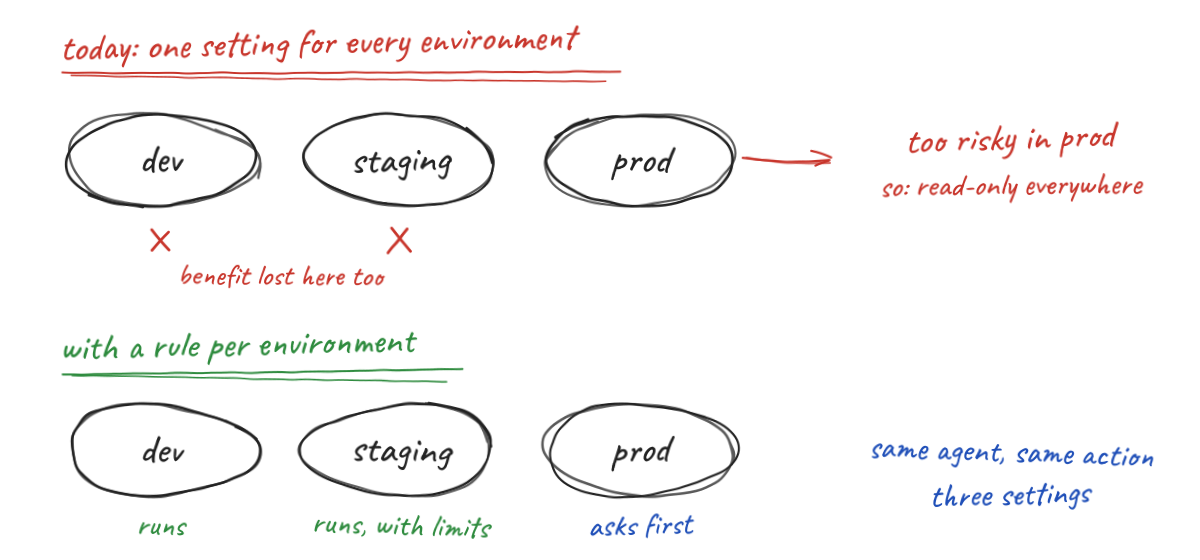
The team then gets no benefit in dev and staging either, where the work was safe to hand over. The agent stops at read in every environment, and people do the rest.
Taking more risk in production is the wrong answer. The same agent needs a different setting per environment, and something has to decide per action and per environment. I come back to this at stage 5.
How teams actually run it
Four AI assistants sharing one context across SRE, FinOps, Kubernetes and CloudOps, with every change gated on human approval.
Stage 4: you approve each change
A team that crosses the wall starts at stage 4, and it should. A person is in the loop for every change. A useful approval request shows four things:
- The exact change. The command or the diff, and not a description of it.
- The target. Which cluster, which namespace, which resource.
- The reason. The evidence that led to it.
- The way back. How it is undone when it goes wrong.
You say yes in Slack or in the ticket. Then the agent runs the change under its own identity, with access issued for that one change. It checks the result and writes everything to a log.
The difference from stage 3 sounds small. At stage 3 you copy the command and run it with your own access. At stage 4 you never open the terminal.
A run of steps has a practical form of this. The agent shows the whole plan, you approve it once, and it runs the steps. It stops and asks when anything departs from the plan.
Why a team cannot stay at stage 4
A team cannot stay at stage 4 because the approver becomes the bottleneck.
Stage 4 works well in the first weeks. Then the volume grows. The agent is fast, and every change it prepares lands in front of the same few people. One patch is six steps. One patch round is hundreds of hosts.
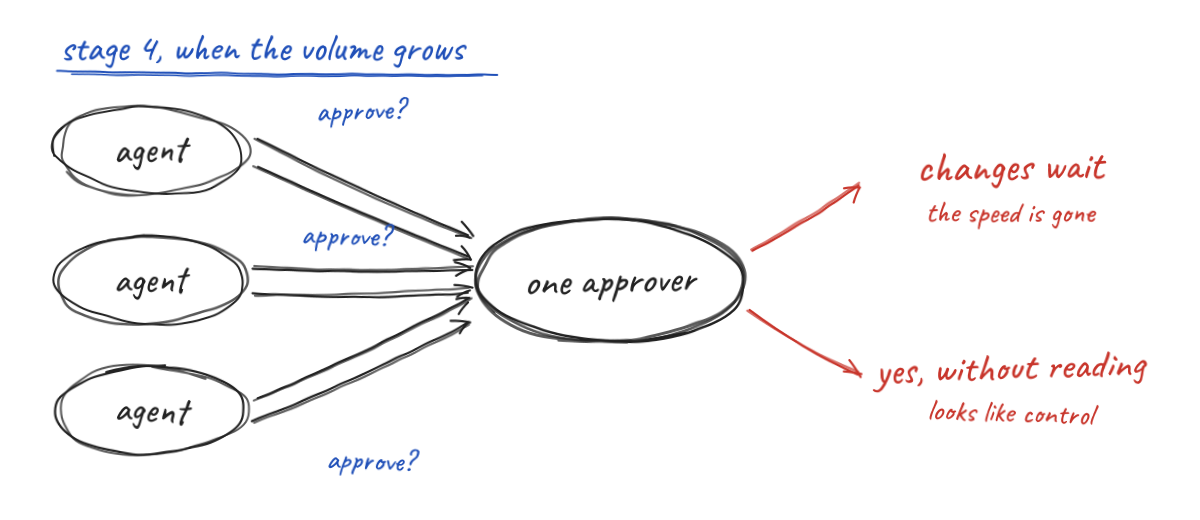
One of two things happens. The changes wait for the approver, and the speed is gone. Or the approver starts to click yes without reading. The second is worse, because it looks like control and nobody is checking.
Developers know this problem from pull requests. Code gets written faster than it gets reviewed. The reviewer becomes the bottleneck. After a while a diff gets approved that nobody read.
Coding teams solved this with automated checks: tests, linters, required checks on the branch. Adding reviewers did not scale. A machine checks every change the same way, and people review what the machine cannot judge.
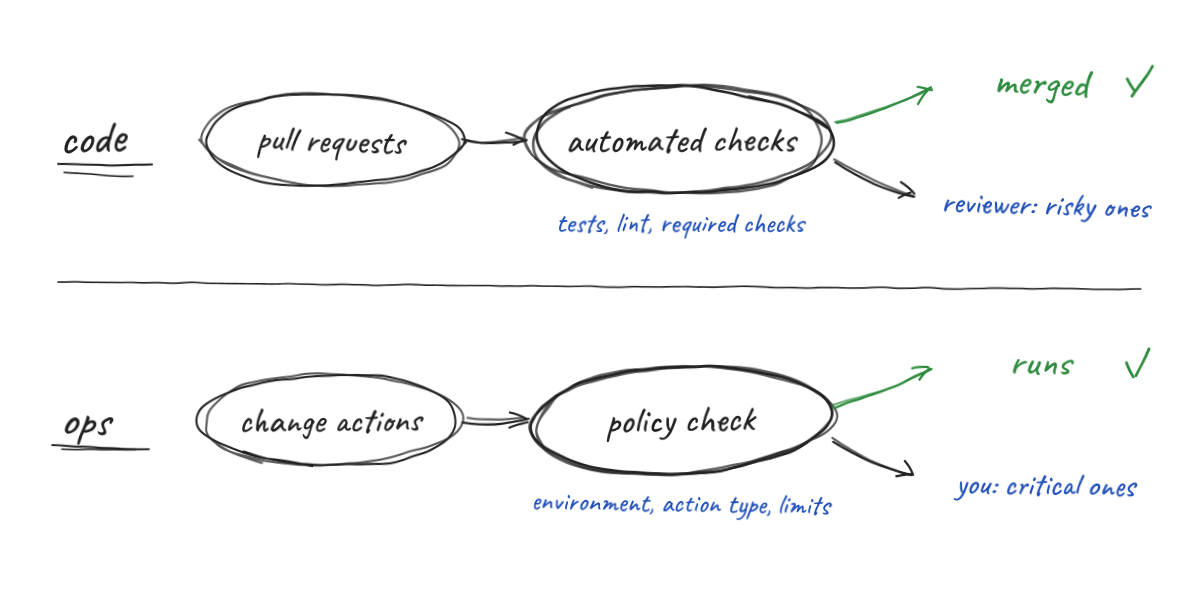
Ops needs the same move, and that move is stage 5.
Stage 5: you approve the rule
At stage 5 you stop approving each change. You write down once what kind of change is allowed. A rule is scoped: which agent, which type of action, which environment, how much, how often, and what to do in the edge cases.
This also solves the environment problem. The same action can have a different answer in each environment. For example:
agent: patch-manager
action: apply security patch
dev: allow
staging: allow, up to 10 hosts per hour
prod: ask first, approve the plan
This is an illustration. It is not the syntax of any product.
A policy check then looks at every change before it runs. It does what a careful approver would do: check the target, the size, the timing and the limits. It does this for every change, the same way, and it does not get tired. In a run of steps it checks each step, so a run can be mostly automatic with one gate at the risky step.
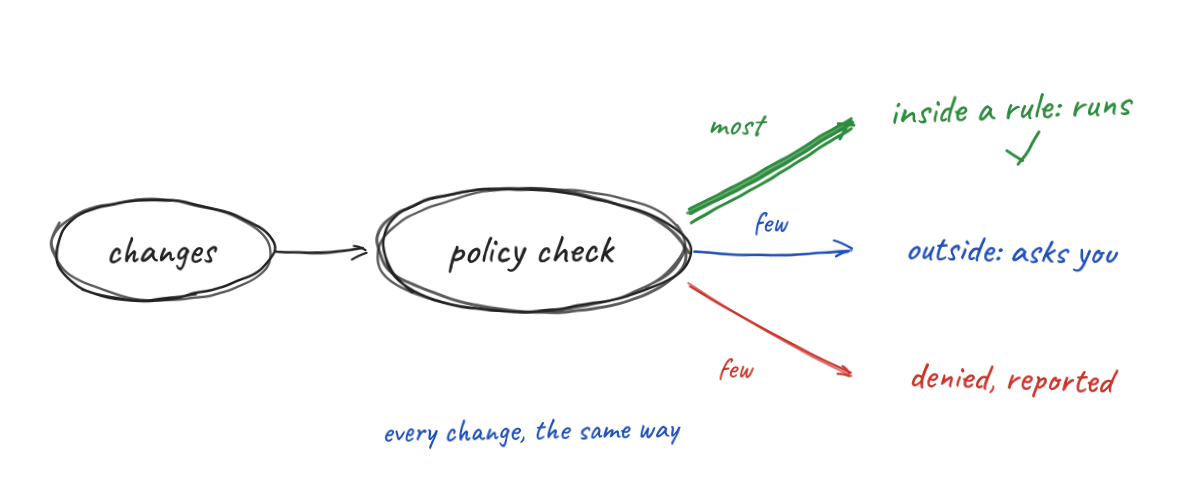
Most changes are inside a rule, and they run. A few are outside, and they come to you as at stage 4. Some are denied. You are involved where the change is critical or new, and that is where your judgment is worth the time.
Policy is to ops changes what CI is to pull requests.
There are two limits, and I want to be honest about them.
- A bad rule repeats its mistake at speed. Rules carry limits on how much and how often. A new rule runs in watch-only mode first. Changes that cannot be undone stay on approval per change, on purpose.
- The comparison with CI is not exact. Tests check whether code is correct. Policy checks whether a change is allowed. Correctness comes from the check after the change, and from being able to undo it.
A human is still involved at stage 5. The work has moved from approving changes to writing rules, reading the log and handling the exceptions.
Why maturity is a grid and not one number
Maturity is a grid of work type against environment. A team has no single stage, because ops is many kinds of work and each kind runs in several environments.
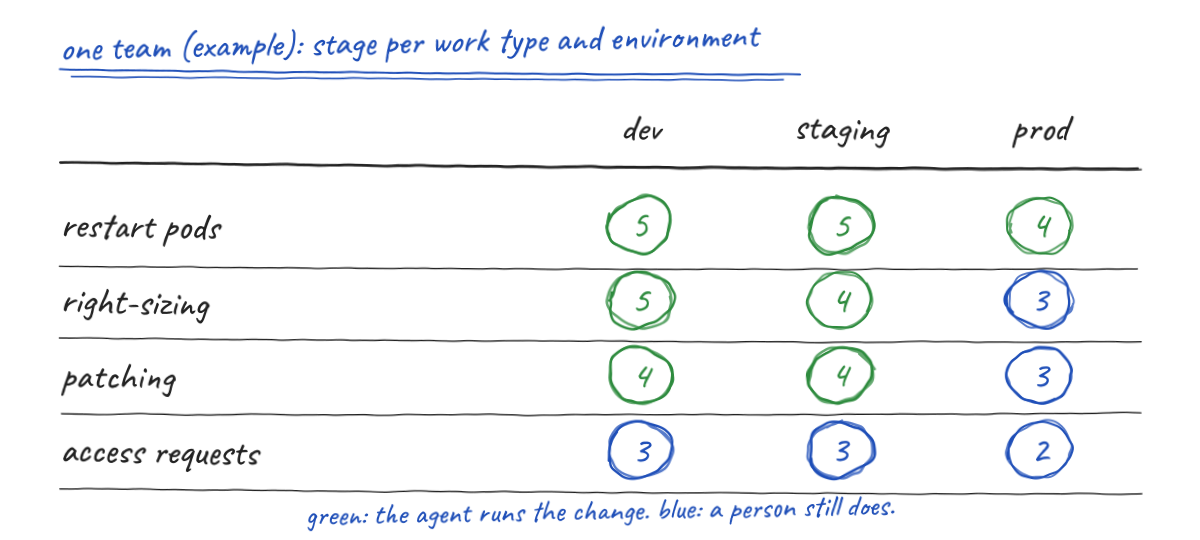
This example team lets the agent restart pods by rule in dev and staging, and with approval in production. Patching runs with approval in the lower environments and is still a recommendation in production. Access requests are on the read side everywhere. This is normal, and I think it is the right way to grow.
The grid shows where to start: work that is frequent, that can be undone, in the lowest environment.
It also shows how to write rules. With this many kinds of work, a rule per task does not hold. A rule per class of step (read, can undo, cannot undo, privileged) and per environment covers all of them.
So I do not ask what stage a team is at. I ask it per type of work and per environment.
Start free, any scale
Readable source, self-hosted, and free at any scale. 2 clusters or cloud accounts free on Cloud SaaS.
How to move from stage 3 to stage 5
A team moves in small steps, starting where a mistake costs least. Nobody jumps from 3 to 5.
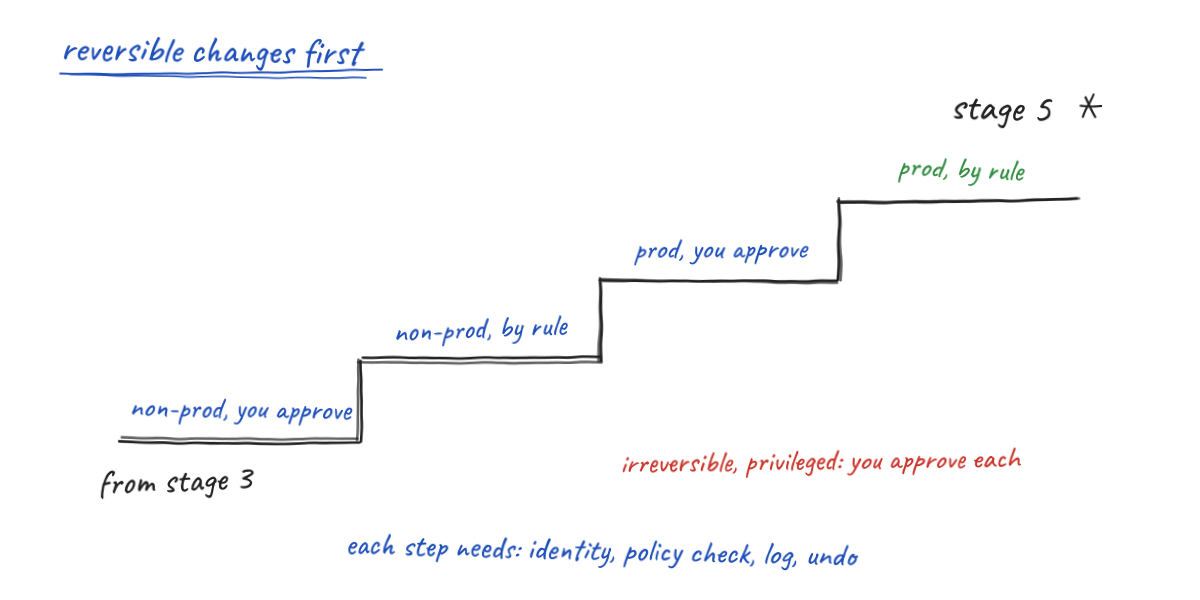
1. Pick one type of work with changes you can undo. Restarts and scale-ups are good first candidates.
2. Non-production, you approve each change. Watch what the agent proposes. Count how often you say no.
3. Non-production, by rule. When you say yes nearly every time, write the rule.
4. Production, you approve each change. Same work, same agent, higher stakes.
5. Production, by rule. Only for the changes where your approvals have become routine.
Keep changes that cannot be undone, and privileged ones, on approval. Deleting data or granting access may stay at stage 4 for a long time. That is fine.
The signal to move up is a boring approval. When you approve the same kind of change every time without thinking, that approval is already a rule that nobody wrote down. This is what stage 4 is for. It is where you learn what the rule should say.
Check your own setup
Take each type of work your team does, in each environment, and answer four questions about its riskiest step.
1. Who finds the cause?
2. Who proposes the fix?
3. Who says yes, and is it per change or by rule?
4. Who runs the command, and with whose access?
When the answer to the last question is always a person, that work is on the read side of the wall, however good the agent's answers are.
Summary
- Agentic ops maturity is how far an agent is trusted to go, measured by who runs the command and who said yes.
- There are five stages: answers, investigates, recommends, makes the change with your approval, makes the change under your rule.
- Most teams I talk to are at stage 2 or 3. Passing the wall needs the agent's own identity, permission per action, a record of the yes and a way to undo.
- Real ops work is many kinds of work, in several steps, across environments. The question has to be asked per step and per environment.
- Approving every change by hand becomes a bottleneck, as pull request reviews did. Rules checked on every change are the way past it.
- Maturity is a grid of work type against environment. Start with frequent, reversible work in the lowest environment.
At NudgeBee we build for stages 4 and 5: agents with their own identity, and a policy check outside the model. I leave it at that here. I would like to hear where your experience of these stages is different.
FAQs
A team cannot stay at stage 4 because the approver becomes the bottleneck.
One of two things happens. The changes wait for the approver, and the speed is gone. Or the approver starts to click yes without reading.
Reaching stage 3 depends on better answers. Going past it is a different kind of problem. An agent that runs the command needs four things that reading never needed:
- Its own identity. Not your login, and not one shared service account.
- Permission per action. Access for the one change, and not for everything the agent might ever do.
- A record of the yes. Who approved, or which rule allowed it.
- A way to undo. Known before the change runs.

Rakesh Rajendran is Founder & CEO of NudgeBee, where the team builds an Agentic Operations and Automation Platform that helps cloud, SRE, FinOps and platform engineering teams run AI agents safely in production.
He has spent two decades building distributed systems for large enterprises, and holds a patent in distributed photo-processing workflows developed at Walgreens. As a serial entrepreneur and intrapreneur, he has built and taken multiple products to market, and speaks regularly on building enterprise-grade agentic systems that meet real enterprise standards for security, control and scale.
Most of his time now goes to one problem: closing the gap between an AI agent that demos well and one an enterprise can actually trust on production systems. Find him on LinkedIn or reach the team at nudgebee.com.