
I talk to many platform and SRE teams about AI agents. Almost all of them have already started. Almost all of them have stopped at the same point. The agent can read production and explain what it sees. It is not allowed to change anything.
I do not think these teams made wrong choices. Each step was reasonable when they took it. I think the ceiling comes from how these setups are built. In this post I write down the path I see most teams take, where each step stops, and what I think has to change.
One disclosure. I work on NudgeBee, where we build agents for ops. I keep the product out of this until the last section.
The stages below are not a strict sequence. Many teams are in two or three of them at the same time.
Stage 1. The assistant in the terminal
This is where everybody starts. An engineer connects Claude or Copilot to the cluster or the cloud account, through kubectl, a cloud CLI or an MCP server, and asks questions.
It works well. There is no setup and no budget request. It finds the failing pod, reads the stack trace and writes the query nobody remembers.
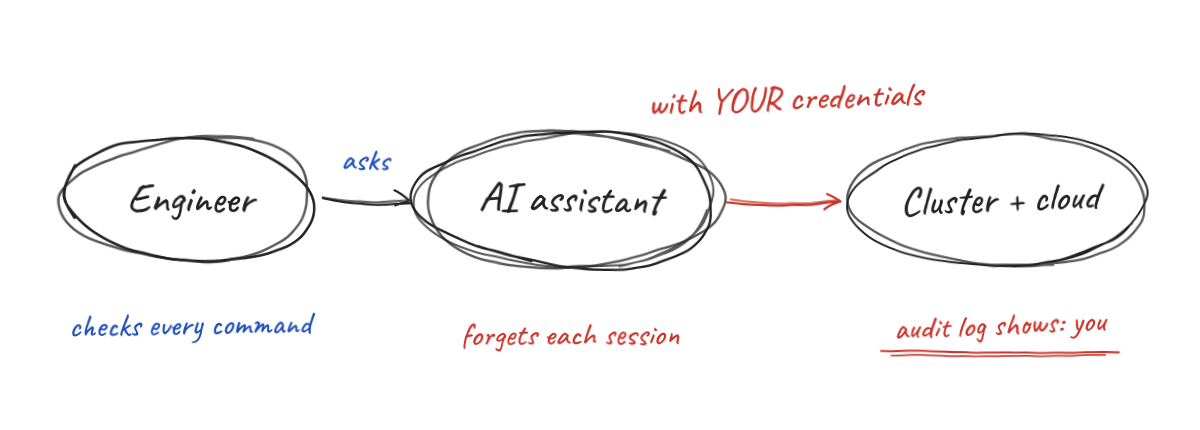
It stops for simple reasons.
- It runs as you. The assistant uses your kubeconfig and your cloud credentials. Whatever you can do, it can do. The audit log shows your name.
- It is a shell. The only control is you, reading every command before you press enter.
- It works only when asked. Nobody is at the keyboard when the disk fills up on Sunday.
- It forgets. Every session discovers the environment again from zero, and you pay the tokens for that again.
- Two people, two answers. Ask the same question twice and you get two different investigations.
Stage 2. The orchestrator you build
The team sees the value and wants more. So they build. An agent framework, a few specialised agents, prompts, tools wired to their own stack, triggered from alerts or Slack.
This also works, at first. It fits the stack exactly. The team understands every part. The first root cause summary on a real alert is a good day.
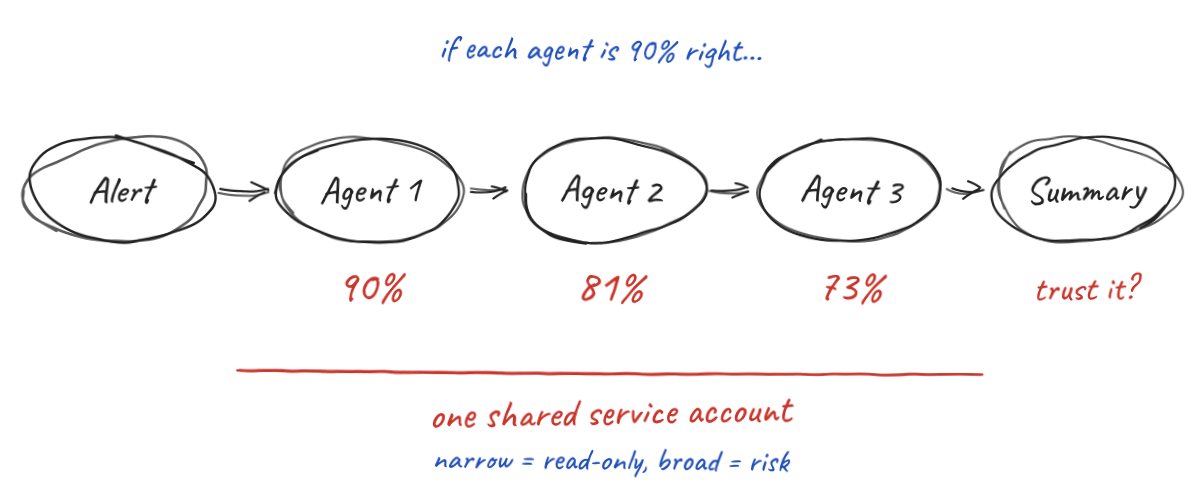
Then the problems arrive, usually in this order.
- Errors add up. One agent's guess becomes the next agent's fact. Three agents that are each 90% right give you about 73%. Five give you 59%. This is simple multiplication, not a measurement, but the direction is real.
- You cannot say how right it is. To know, you need an evaluation set. Building and keeping that set is a project by itself.
- A new model breaks things. Tool calling behaves differently, output format shifts, prompts need tuning again. Nobody has the time to retest. So the team stays on an old model, or upgrades without testing.
- The identity problem shows up. The agent now runs as a service account. If you keep the access narrow, it can only read. If you make it broad, you have a standing credential that a prompt can misuse.
- Token cost grows quietly. More agents, more context per step. The bill comes after the design is fixed.
- Two engineers become a product team. Integrations, upgrades, on-call for the agent itself. The team wanted less toil and now maintains one more system.
Stage 3. The agent inside each tool
While this is going on, the vendors ship their own agents. The observability platform has one. The cloud console has one. The ticketing tool has one. Each is one switch away, so the team turns them on.
The good part is clear. The agent already has the data, there is no new security review, and the vendor maintains the model and the evals.
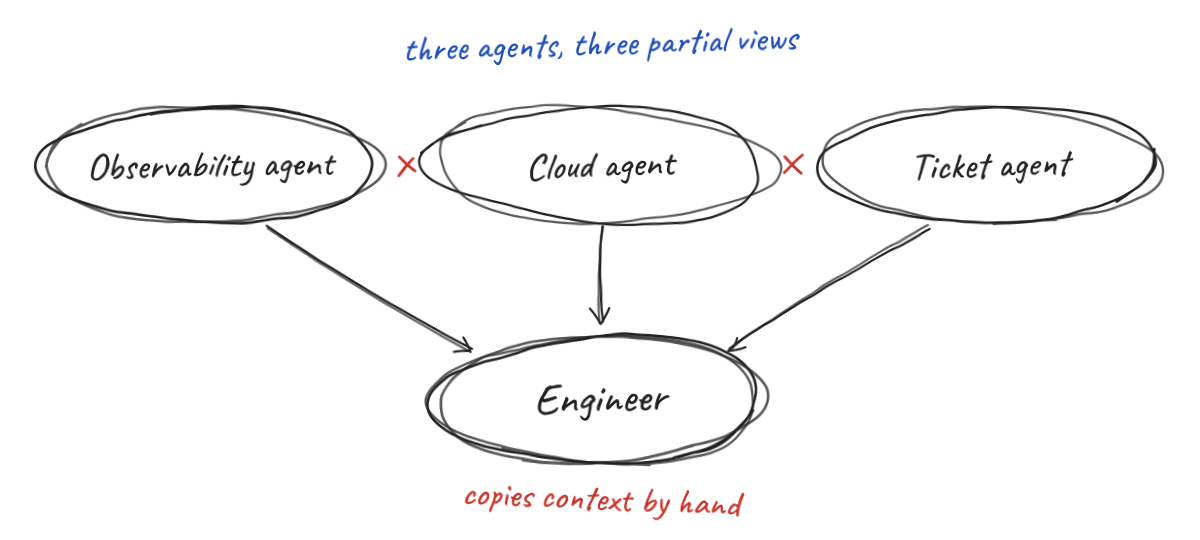
The limits are typical of the category. Individual products differ.
- Each one sees its own platform. The observability agent does not know about the deploy that went out, the cost data, or the second monitoring tool that another team uses.
- It stops at a recommendation. Its job is to explain what its platform observed. Changing production is mostly outside what it is built for.
- The agents do not talk. Three tools, three agents, three partial views. The engineer copies context from one to the other.
- You do not choose the model or the meter. It runs on the vendor's model, in the vendor's cloud, priced per investigation or per token.
Find the root cause faster
NudgeBee finds the root cause of an incident, with evidence, and suggests a fix. Runs self-hosted in your own environment.
Stage 4. The incident-only tool, and the rest of the job
Some teams buy a product built for incident investigation. It does root cause better than a general assistant, and there is less to build. For incidents, this is a fair choice.
But look at what an ops team does in a normal week.
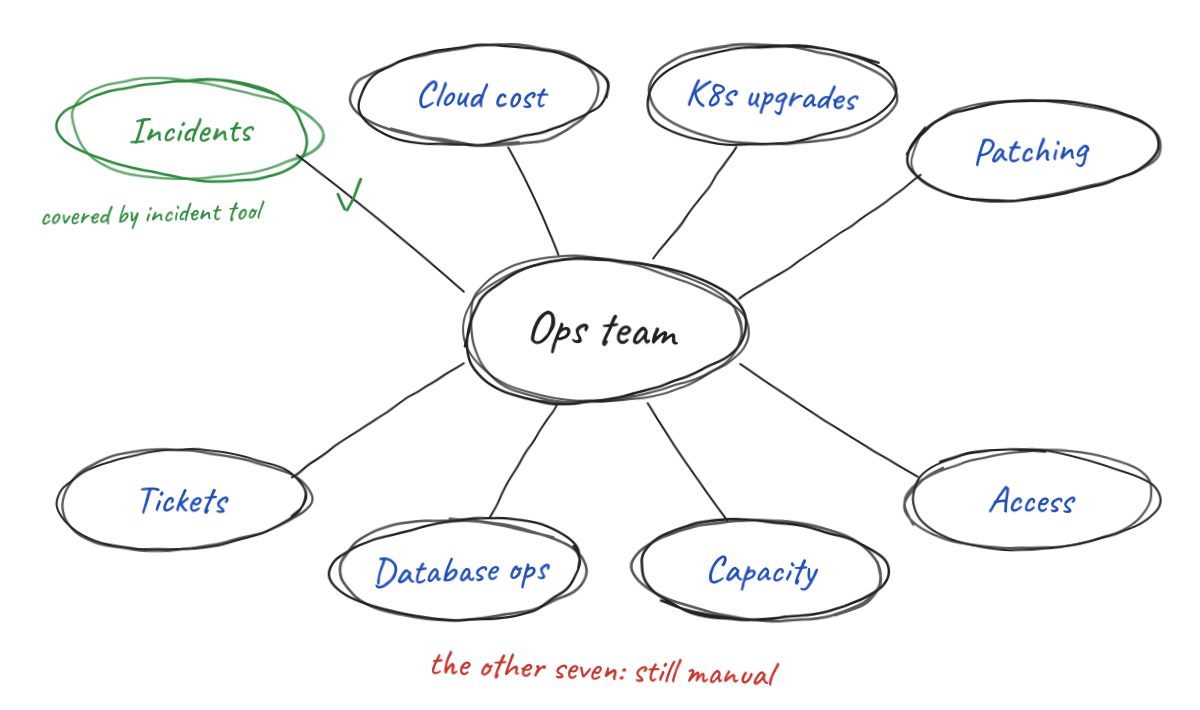
Incidents are the visible part. In the teams I talk to, most of the hours go to the other jobs: right-sizing and cost reviews, cluster upgrades, patching, access requests, database maintenance, the ticket queue. This work is repetitive, it has rules, and it is exactly the toil we hoped agents would take.
Two things follow from this picture.
- An incident agent leaves most toil untouched. It also mostly reads and summarises. The output is a suggested command that a person still runs.
- One agent per job does not scale. If you solve identity, permissions, memory and model upgrades separately for each job, you solve them eight times. These things belong in a common layer under all the agents.
The same ceiling
The four stages look different. They stop at the same place, for the same six reasons.
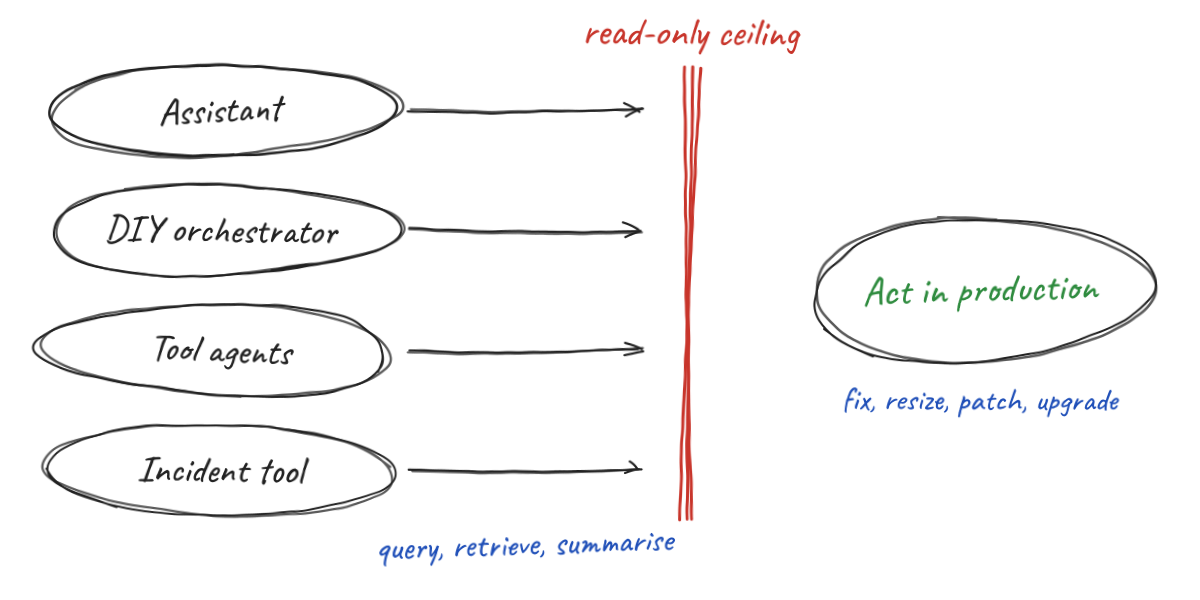
- Borrowed identity. The agent runs as a person or as one shared account. Access is given to the agent as a whole, not to the one action it is about to take.
- Answers you cannot check. Without cited evidence and repeatable runs, a senior engineer has to redo the investigation to trust it.
- Model changes you cannot absorb. Each new version needs evals and retesting that the team has no time for.
- Token cost with no control. Every step uses the largest model, and every run discovers the environment again.
- No memory of your estate. The agent does not know what depends on what, what changed yesterday, or what fixed this last time.
- Built to retrieve, not to act. Acting needs defined actions, permission per action, approval at the right points and a record. None of the four was designed with these.
The first reason causes the last one. Because permission is all or nothing, the only safe setting is read-only. Because the agent is read-only, the team gets explanations and keeps the toil.
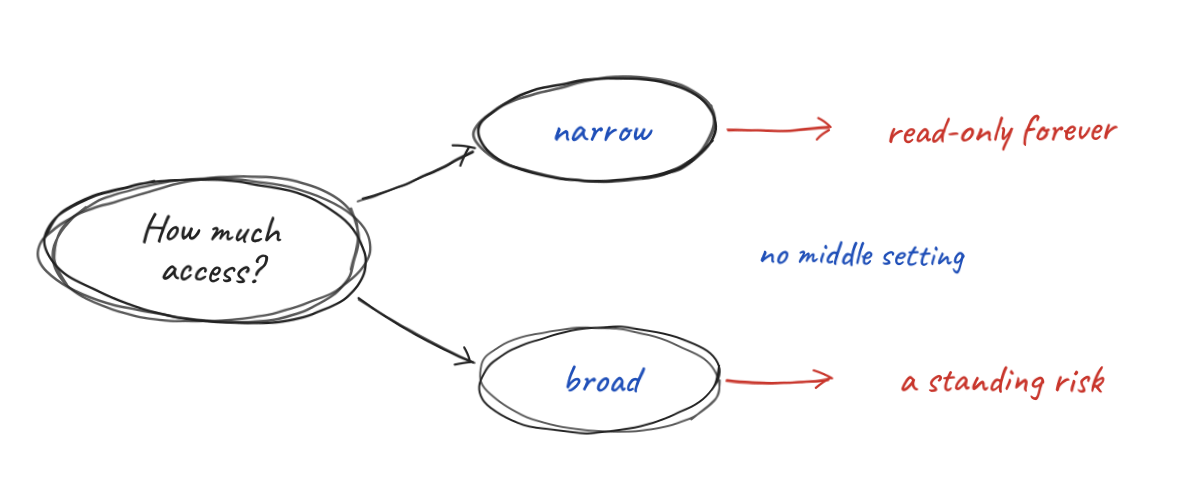
Better answers alone do not fix this. A perfectly accurate agent with a shared admin credential is still not something I would let act in production.
Retrieval is the first step of agentic operations. It is not the destination.
How teams actually run it
Four AI assistants sharing one context across SRE, FinOps, Kubernetes and CloudOps, with every change gated on human approval.
What changes: ops automation, with judgment
We have solved this problem once before. It was called ops automation.
A runbook automation did one defined thing. It had the permission for that job and nothing more. Risky steps needed an approval. Everything was logged. Nobody was afraid of it.
Its weakness was different. Somebody had to predict every situation and write a script for it. So coverage stayed small and the scripts went stale.
Agents have the opposite profile. They can reason about a situation nobody wrote a script for. But we gave them a shell, a broad credential and a prompt that says "be careful".
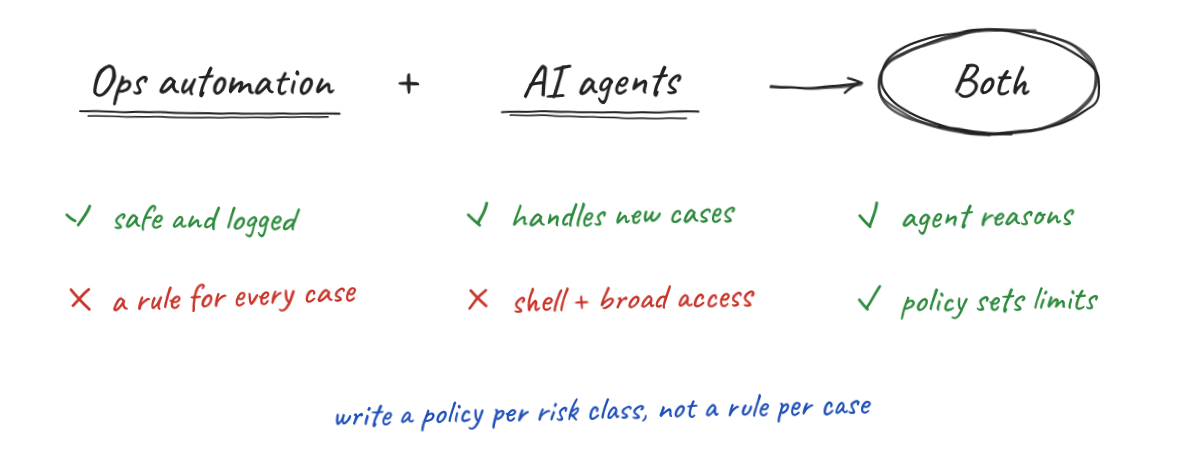
I think the answer is to put the two together.
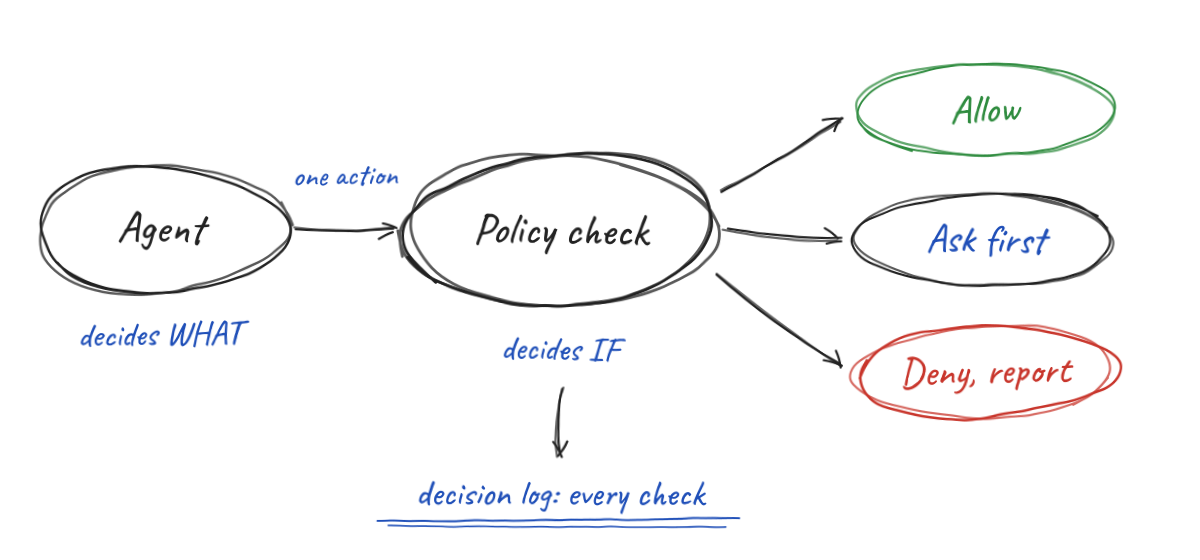
- The agent decides what to do. It investigates, plans and proposes one action at a time. This is the part that is much faster than a person and needs no script.
- Policy decides if it may. A separate layer, outside the model, checks each action against your rules. No model makes this decision, so the result is the same every time.
- Risk classes replace rules. You do not write a rule for every case. You say how each class of action (read, reversible, irreversible, privileged) is treated in each environment.
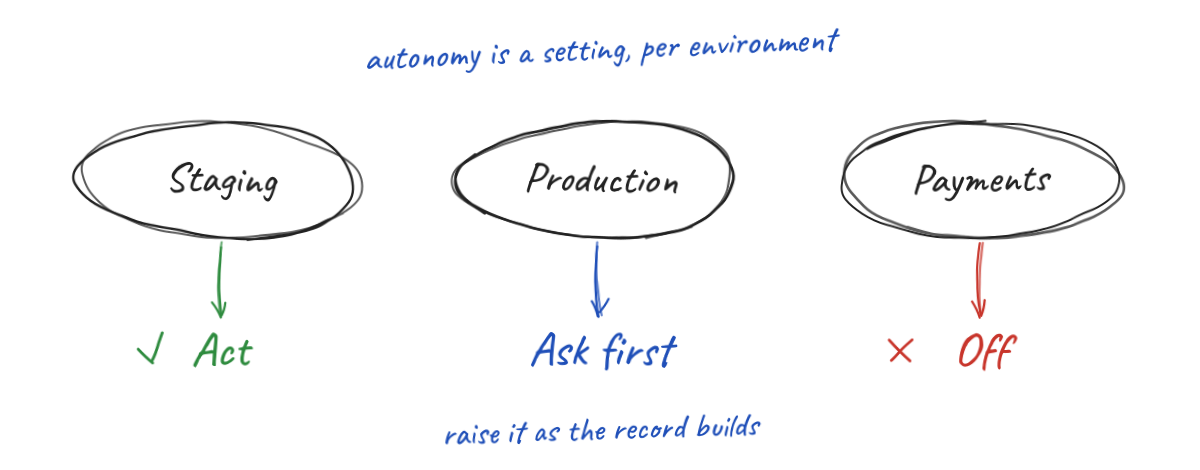
- Autonomy is a setting, per environment. Act in staging. Ask first in production. Off for the payments cluster. You raise it as the record builds.
- When not covered, it stops. The agent asks, or stops and reports. It does not improvise.
Prompts guide. Policy decides. You stop hoping the model behaves, and you control what it is able to do.
How I rate each approach
I scored the four approaches, and the model I argue for, on five parameters. Scores are 1 to 5, and 5 is best. These are my own ratings and I am biased towards the last column. Please argue with them.
- Scope. How many of the ops jobs it covers, across how many tools.
- Reach. How far it goes: answer, investigate, recommend, act.
- Identity and security. Its own identity, permission per action, an audit trail.
- AI cost. Whether you can see and control the token spend.
- Model freedom. Your choice of model, what happens when versions change, and whether it can run self-hosted or air-gapped.
| Parameter | Assistant | Orchestrator you build | Agent inside each tool | Incident-only tool | Agents under policy |
|---|---|---|---|---|---|
| Scope | 3, anything you ask | 2, what you built | 2, one platform | 1, incidents | 4, most ops jobs |
| Reach | 2, acts only through you | 2, read-only in practice | 2, recommends | 2, recommends | 4, acts within policy |
| Identity and security | 1, runs as you | 2, one shared account | 3, vendor role, mostly read | 3, vendor role, mostly read | 5, own identity, access per call |
| AI cost | 3, flat per seat | 2, yours and growing | 2, vendor meter | 2, vendor meter | 4, routed per step |
| Model freedom | 3, pick your assistant | 3, any model, even air-gapped, but you retest | 1, vendor model, no air-gap | 2, limited choice | 4, your choice, tested for you |
| Agentic ops maturity | L1 | L2 | L3 | L3 | L4 to L5 |
The last row needs a definition. By maturity I mean how far the agent is trusted to go.
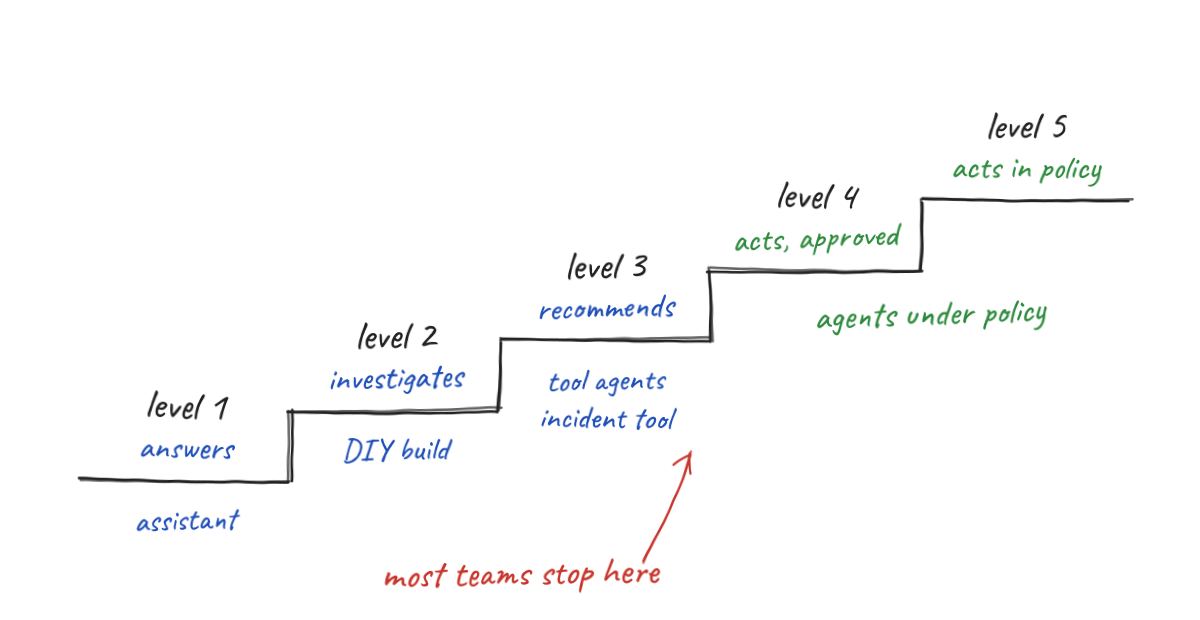
I did not give 5 everywhere in the last column. Scope depends on which integrations exist. And an agent acts within policy only after somebody has written that policy, which is real work in the first weeks.
Six questions for your own setup
If you run agents against your infrastructure today, in any of the four forms, these are worth ten minutes.
- Does the agent have its own identity, or does it run as a person or a shared account?
- Can you show how often its answers are right?
- When the model version changes, who retests?
- Do you know the token cost of one investigation?
- Does it remember your environment between runs?
- Is there any action it may take in production without a person typing it?
If most answers are no, you are in the same place as most teams I meet. It is not a failure. It is where the current approaches end.
Start free, any scale
Readable source, self-hosted, and free at any scale. 2 clusters or cloud accounts free on Cloud SaaS.
What we build
This is the problem we work on at NudgeBee. Agents that each do one job, a policy engine outside the model that decides every action, a graph of your environment so the agent does not start from zero, and a router that sends each step to the right size of model. The core agent is open source.
I will write about each of these in separate posts. If you disagree with the stages or the six reasons, I would like to hear where. I am sure the picture is incomplete.
FAQs
A separate layer, outside the model, checks each action against your rules.
Prompts guide. Policy decides. You stop hoping the model behaves, and you control what it is able to do.
- Does the agent have its own identity, or does it run as a person or a shared account?
- Can you show how often its answers are right?
- When the model version changes, who retests?
- Do you know the token cost of one investigation?
- Does it remember your environment between runs?
- Is there any action it may take in production without a person typing it?

Rakesh Rajendran is Founder & CEO of NudgeBee, where the team builds an Agentic Operations and Automation Platform that helps cloud, SRE, FinOps and platform engineering teams run AI agents safely in production.
He has spent two decades building distributed systems for large enterprises, and holds a patent in distributed photo-processing workflows developed at Walgreens. As a serial entrepreneur and intrapreneur, he has built and taken multiple products to market, and speaks regularly on building enterprise-grade agentic systems that meet real enterprise standards for security, control and scale.
Most of his time now goes to one problem: closing the gap between an AI agent that demos well and one an enterprise can actually trust on production systems. Find him on LinkedIn or reach the team at nudgebee.com.