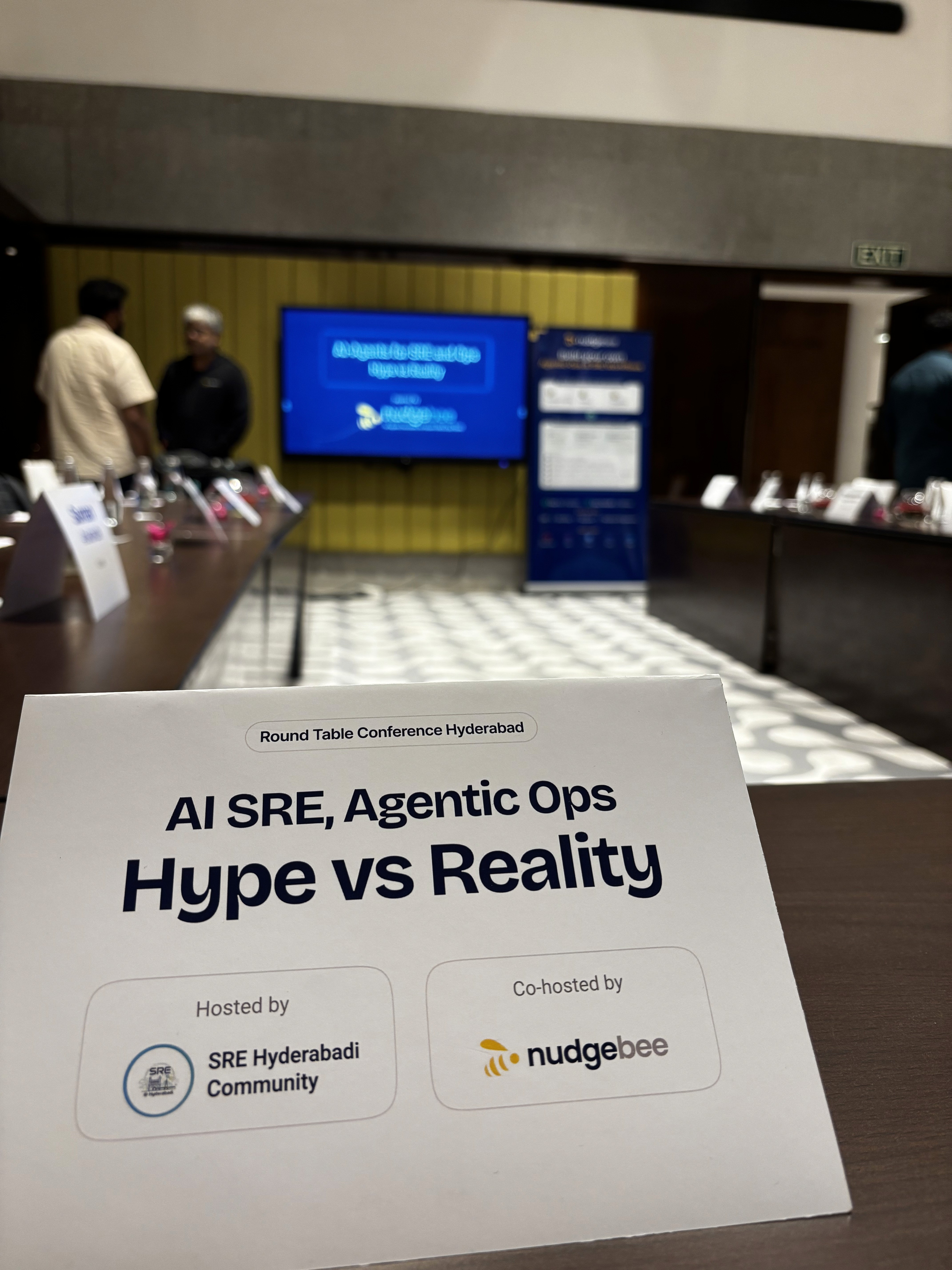
Insights from a Closed-Door Roundtable
This roundtable brought together 15–17 senior SRE, DevOps, and CloudOps leaders from production-heavy environments, including participants from Bank of America, Deutsche Bank, HighLevel, and similar organizations.
The discussion was intentionally closed-door and experience-led. The focus was not on hypothetical AI capabilities or future promises, but on patterns emerging as more SRE and Ops leaders actively work with AI and agentic systems in real production environments.
What follows is not guidance or best practices. It is a synthesis of recurring observations, tensions, and learnings that surfaced as practitioners compared notes on what is holding up in practice , and what is quietly breaking down.
Real vs Perceived Capabilities of AI in SRE
One of the earliest themes to surface was a clear recalibration of expectations.
Across the room, there was alignment that while AI is often positioned as capable of owning operational decisions, its practical value today appears elsewhere. The strongest outcomes were observed when AI was used to assist investigation, correlation, and reasoning, rather than to independently decide or act.
A recurring concern was not accuracy, but confidence without grounding , outputs that sounded certain but lacked clarity around assumptions, trade-offs, or blast radius.
When experiments failed to progress, the underlying issue was rarely the model itself. Instead, limitations surfaced because AI systems lacked awareness of:
organizational decision boundaries
production risk tolerance
ownership and accountability models
The shared conclusion was that AI fits most naturally as an augmentation layer, accelerating understanding rather than acting as an authority in production systems.
Agentic Automation Works , Only When Intent Is Explicit
As the discussion shifted to agentic workflows, a consistent pattern emerged around where these systems began to feel viable.
Agentic setups showed promise when human intent was explicit and preserved throughout the workflow. Systems focused on investigation, planning, and option generation were repeatedly described as useful. Systems that crossed into autonomous execution, especially without clear approval boundaries, were described as fragile.
What stood out was that resistance was not to automation itself, but to automation without clarity of intent, approval, and accountability.
Agentic systems that endured were those designed to behave predictably , proposing actions, surfacing trade-offs, and deferring execution until intent was confirmed.
The Real Bottleneck Is Context, Not Fixes
Another strong insight emerged as participants reflected on where time is actually lost during incidents.
Across environments, the slowest part of incident response was not implementing fixes, but reconstructing context , assembling logs, metrics, traces, tickets, runbooks, and historical discussions scattered across tools.
AI was seen to add the most value when it reduced this fragmentation. By stitching together related signals and highlighting what changed, it helped compress the time required to understand a situation , even when the final decision remained human.
This reframed success away from “AI resolved the incident” toward reducing cognitive load during the most mentally expensive phase of response.
Regulated and High-Stakes Systems Change the Equation
Participants operating in regulated or high-impact domains consistently highlighted a different set of constraints.
In these environments, speed alone is not the primary objective. Fast but opaque actions can introduce compliance risk, audit failures, or downstream harm. As a result, explainability and traceability were repeatedly emphasized over autonomy.
AI usage in these contexts skewed toward:
investigation and analysis
documentation and consistency
safer, more predictable execution paths
This posture was not framed as resistance to AI, but as realism shaped by consequences.
Where Impact Is Quietly Emerging
Without framing it as “transformation,” several patterns of impact surfaced.
Across the discussion, AI was described as contributing to:
faster narrowing of likely root causes
reduced dependence on a small number of senior experts
better capture of reasoning that previously lived only in people’s heads
Across implementations discussed in the room, several quantified patterns emerged repeatedly:
35% faster incident resolution was a common baseline, with some teams reporting MTTR dropping from hours to minutes once AI-guided troubleshooting workflows were active.
30–60% reduction in cloud spend through AI-driven workload rightsizing and anomaly-based resource optimization, without changing observability vendors.
70% fewer Kubernetes-related developer tickets in one enterprise after deploying AI agents that could diagnose and recommend fixes for common cluster issues.
40% of routine incidents auto-resolved monthly in teams that had moved well-understood failure patterns into automated remediation playbooks.
One participant described reducing cloud costs by 40% within five weeks, not by replacing tools, but by activating AI-powered optimization workflows on top of their existing Prometheus and Datadog setup.
These gains were not sudden or dramatic. They accumulated gradually as AI was applied consistently to the same high-friction parts of day-to-day operations.
The AI-Agentic Ops Triangle: A Framework for Enterprise Adoption
A recurring mental model that emerged across the discussion was what several participants called the AI-Agentic Ops Triangle. Enterprise leaders who reported sustainable results framed their AI adoption around three balanced pillars:
Pillar | What It Means | How It Was Measured |
Productivity | Automating toil and enabling less experienced engineers to handle more complex issues independently | Tasks automated per month, escalation rate, percentage of incidents resolved by L1/L2 without escalation |
Accuracy | Reducing false positives and ensuring that AI-recommended fixes are reliable and explainable | False positive rate, fix success rate, RCA accuracy score |
Cost | Optimizing infrastructure spend without inflating it through additional AI tooling overhead | Cloud spend reduction %, cost per incident, tool consolidation savings |
The shared observation was that when AI agents are deployed with all three pillars in balance, they deliver sustainable enterprise ROI. When any one pillar is neglected, particularly accuracy or cost, the initiative tends to stall or lose organizational trust.
Why Small, Purpose-Built Agents Felt Safer
Another theme that emerged through comparison of experiences was agent design.
Broad, general-purpose agents were repeatedly described as harder to trust. As scope expanded, behavior became more difficult to reason about and failures harder to isolate.
In contrast, small, narrowly scoped agents were described as more predictable and easier to validate. Clear boundaries made it easier to understand what an agent was responsible for, how it might fail, and how to improve it over time.
The underlying driver here was not technical elegance, but cognitive safety.
Autonomy Only Worked When It Was Reversible
There was strong alignment on where autonomy felt acceptable.
Autonomous actions were viewed as reasonable when the blast radius was low and recovery was simple , such as creating tickets, opening pull requests, enriching alerts, or generating summaries.
For actions that could materially affect production, autonomy consistently stopped at decision support. AI could propose plans or generate artifacts, but execution required explicit human approval.
This boundary was framed not as limiting AI, but as preserving trust.
Mindset and Learning Velocity Matter More Than Tools
As the discussion closed, attention turned to learning dynamics.
A recurring observation was that waiting for AI to “settle” slowed learning. Those who began experimenting earlier , even cautiously , developed intuition and judgment that compounded over time.
Closing Reflection
The strongest alignment across the room was not around a specific tool or architecture.
It was this:
“AI works best in SRE and CloudOps when it helps humans think better , not when it tries to think instead of them.”
The future isn’t autonomous systems running themselves. It’s experienced operators, supported by better context, lower cognitive load, and intentionally designed automation.
FAQs
What does AI in SRE actually do?
AI agents automate troubleshooting, optimize cloud costs, and reduce operational toil. They allow engineers to focus on higher-value work like architectural improvements and reliability strategy rather than repetitive firefighting.
How does AI reduce mean time to resolution (MTTR)?
By analyzing logs, metrics, and traces in real time, AI agents identify probable root causes and suggest fixes faster than manual investigation. Teams using AI-assisted workflows typically report MTTR reductions of 35% or more.
Can AI in SRE actually reduce cloud costs?
Yes. Through workload rightsizing and anomaly detection, enterprises in the roundtable reported saving 30–50% on cloud spend without changing their existing observability vendors.
Is AI in SRE safe for regulated industries?
Yes, when deployed with explainability and traceability as core requirements. Platforms that support on-premise deployments with RBAC, MFA, and compliance frameworks are being adopted in banking, healthcare, and government environments.
Do AI agents replace SRE engineers?
No. The consensus across the roundtable was clear: AI works best when it helps humans think better, not when it tries to think instead of them. AI handles repetitive investigation and correlation; humans retain judgment and accountability.
Can small SRE teams benefit from AI?
Absolutely. AI levels the playing field by enabling small teams to manage enterprise-scale complexity with fewer escalations, faster context assembly, and less on-call burnout.